
Last Updated: November 21, 2026
Quick Summary
Non preachy picture books are stories that let children feel a message rather than be told one, with the tale unfolding and the meaning landing quietly without a narrator wagging a finger. The best titles teach life lessons through consequence, not commentary, so the child absorbs the message on their own terms. Read the final page aloud: if it sounds like a school assembly speech, the book is preachy.
- Read the final two pages before buying, as a book can turn didactic on the last spread.
- Twelve to sixteen spreads is a comfortable preschool length for holding attention.
- Wordless titles such as Aaron Becker's Journey let a child read and narrate alone.
- Ask open questions like what would you have done rather than what did we learn.
- A good picture book survives the hundredth reading, so favour titles with layers.
Table of Contents
- What Makes a Picture Book Non-Preachy
- Picture Books That Teach Life Lessons Without Being Preachy
- Picture Books for Preschoolers: Matching the Book to the Child
- Picture Books With Brilliant Illustrations and Few Words
- Classic and Contemporary Titles Worth Repeating
- How to Talk About a Book's Message Without Turning It Into a Lesson
- Building a Reading Shelf That Follows Your Child's Lead
- Frequently Asked Questions
What Makes a Picture Book Non-Preachy
Non-preachy picture books are stories that let children feel a message rather than be told one. The tale unfolds, the characters act, and the meaning lands quietly, without a narrator wagging a finger at the end.
Books where the story comes first and any lesson is a by-product, never the point, are the ones worth choosing. That distinction matters more than most buyers realise.
The tell-tale signs of a lesson in disguise
Watch for a story that stops being a story. The characters pause mid-adventure to explain what they have learned, or an adult voice appears to summarise the moral. Another giveaway is a plot built backwards from a theme: a book about sharing where the child exists only to learn about sharing.
The test is simple. Read the final page aloud. If it sounds like a school assembly speech, the book is didactic, heavy-handed, and preachy. If it ends on an image, a joke, or a feeling, you have found something better.
Picture Books That Teach Life Lessons Without Being Preachy
The best picture books that teach life lessons without being preachy do it through consequence, not commentary. A character makes a choice, lives with the result, and the young reader absorbs the lesson on their own terms. That is how a story earns its message, and it is one of the clearest tests of whether a book is worth reading aloud.
Julia Donaldson and Axel Scheffler's The Gruffalo never tells children to be brave; the mouse simply is brave, and clever with it. Judith Kerr's The Tiger Who Came to Tea says nothing about hospitality. It just lets a tiger drink all the water in the tap, and children adore it.
How a story earns its message
A message feels earned when the reader discovers it. The child notices the character's worry, recognises it, and follows the resolution without being instructed. That is visual storytelling doing the emotional work.
Three mechanisms do most of the heavy lifting:
- Consequence over commentary. The character acts, something follows, and the book trusts the child to connect the two. Anthony Browne's Voices in the Park shows how adults and children read the same afternoon differently, and never once tells the reader which reading is correct.
- Feeling shown in the body. A slumped shoulder or a wide eye carries more than a caption. In Jon Klassen's I Want My Hat Back, the bear's flat stare does all the moral work, and children spot the joke before adults do.
- An ending that stays open. Books that close on an image or a question leave room for the child to finish the thought. Shaun Tan's The Lost Thing ends on a quiet image rather than a statement, and the ambiguity is the point.
Books that lecture skip these steps entirely. The child is told what to conclude before they have felt anything, and the story becomes a delivery vehicle for a lesson. Teachers and parents often find that children switch off the moment they sense they are being managed.
Titles screened for preachiness
A useful screen is to read the final page aloud, and if it sounds like a school assembly speech, the book is probably not a good fit. The titles below pass this test because each one lets the reader arrive at the meaning unaided.
- The Gruffalo by Julia Donaldson and Axel Scheffler, courage and quick thinking, delivered through a clever mouse and a hungry predator.
- The Tiger Who Came to Tea by Judith Kerr, hospitality and surprise, with no narrator explaining either.
- Where the Wild Things Are by Maurice Sendak, anger and belonging, resolved through a wild rumpus and a warm supper rather than a lecture.
- Lost and Found by Oliver Jeffers, friendship and letting go, told through a boy, a penguin and a long journey home.
- I Want My Hat Back by Jon Klassen, honesty and consequence, landed as a deadpan joke children relish.
- Voices in the Park by Anthony Browne, perspective and empathy, shown through four voices describing one walk.
Watch out: a book can look non-preachy on the cover and still turn didactic on the last spread, so always read the final two pages before buying rather than trusting the blurb.
Picture Books for Preschoolers: Matching the Book to the Child
Picture books for preschoolers work best when they match the child, not the reading level chart. A four-year-old who loves animals will sit through a longer animal story; the same child may wriggle through a short book about feelings.
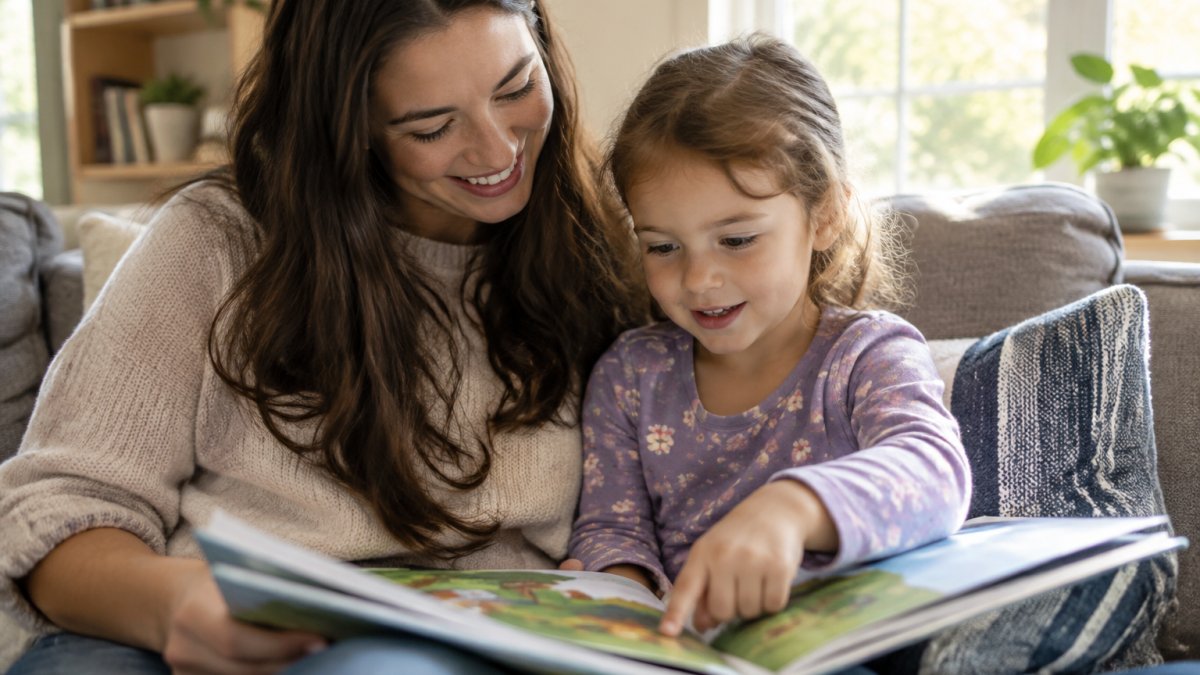
Children should not be pressured when choosing books. Following their lead and interests works best. A child who is drawn to dinosaurs will learn more from a dinosaur adventure than from a worthy book about tidying up.
Age bands and what to expect at each stage
- Toddlers (1-2): board books, bold illustrations, rhythm and repetition, very few words. Expect a page or two of attention at a time and plenty of chewing.
- Early preschoolers (3-4): simple plots, humour, familiar routines, read-aloud appeal. A story that can be finished in five minutes suits most sittings.
- Older preschoolers (4-5): longer stories, richer characters, gentle emotional themes. Children at this stage start predicting endings and asking 'why' questions mid-story.
- Early primary (5-7): wordplay, adventure, books that reward rereading. Independent browsing becomes realistic, so covers and illustrations matter more.
Matching the book to the reading context
The same child needs different books at different moments, and the context is often a better guide than the age band.
- Bedtime: choose calm, rhythmic stories with a settled ending. The Tiger Who Came to Tea works because the disruption resolves into ordinary domestic comfort. Avoid titles with a loud comic payoff right before lights out.
- Nursery or group reading: pick books with a repeated refrain children can join in with, such as Kes Grey's Oi Frog!, where the rhyme invites a whole room to shout the next line.
- Independent browsing: wordless and near-wordless titles let a child 'read' alone without needing an adult to decode text. Aaron Becker's Journey is the strongest example, because the pictures carry the entire plot.
- After a difficult day: gently thoughtful books about big feelings, read one-to-one, give a child language for a mood without an adult naming it for them.
Practical notes for parents and carers
A few quick checks save a lot of mid-story negotiations:
- Length: count the spreads, not the pages. Twelve to sixteen spreads is a comfortable preschool length; anything longer needs a strong refrain to hold attention.
- Read-aloud suitability: read the book silently first. If you stumble over the rhythm, the child will too.
- Possible sensitivities: some much-loved titles include mild peril, a character being eaten or a child running away from home. None of these are reasons to avoid a book, but knowing in advance lets you pause and talk if your child needs it.
- Rereading tolerance: if you cannot face the hundredth reading, the book is not right for your shelf.
If you want deeper guidance on choosing for this age group, our guide on how to choose bedtime books for preschoolers walks through it step by step.
Matching the book to the child means weighing attention span, current obsession and reading context together, and the age bands below show what to expect at each stage.
| Stage | Age | What suits them |
|---|---|---|
| Toddlers | 1-2 | Board books, bold illustrations, rhythm and repetition, very few words |
| Early preschoolers | 3-4 | Simple plots, humour, familiar routines, read-aloud appeal |
| Older preschoolers | 4-5 | Longer stories, richer characters, gentle emotional themes |
| Early primary | 5-7 | Wordplay, adventure, books that reward rereading |
Age
Picture Books With Brilliant Illustrations and Few Words
Some of the strongest non-preachy picture books for children carry their story almost entirely in pictures. Wordless picture books and near-wordless titles build visual literacy, letting a child read the illustrations and narrate the tale themselves.
Aaron Becker's Journey tells an entire adventure through artwork alone. Jon Klassen's I Want My Hat Back uses flat, deadpan illustrations and a handful of lines to land a joke children spot before adults do. Fewer words often mean more imagination and creativity, because the child fills the gaps.
Look for illustrators whose characters show feeling through posture and expression. That is where young readers learn to read emotion, not from a caption telling them how someone feels.
Classic and Contemporary Titles Worth Repeating
A good picture book survives the hundredth reading. That is the real test, and it is why we favour titles with layers: a story a toddler enjoys and an older child still finds funny.
Classic books such as Where the Wild Things Are by Maurice Sendak and The Very Hungry Caterpillar by Eric Carle have earned their place because the storytelling never lectures. Modern books carry the same quality. Oliver Jeffers builds curiosity and quiet wonder into stories like Lost and Found, while Kes Grey's Oi Frog! is pure playful humour with rhyme children shout along to.
If you want to browse the full range and see which titles spark that urge to dive straight in, our children's books collection is the place to start.
How to Talk About a Book's Message Without Turning It Into a Lesson
The conversation after the story is where a book's message can breathe or die. Ask open questions and let the child lead. "What would you have done?" works far better than "What did we learn about sharing?"
The best discussions often start with the pictures. Point to a character's face and ask what they might be feeling. Let the child guess, disagree, and change their mind. For practical help on building this habit, our guide on reading books every day with your children shows how small daily moments make these conversations natural.
Resist the urge to summarise. If the book did its job, the child already has the message. Your role is to wonder alongside them, not to mark their comprehension.
Building a Reading Shelf That Follows Your Child's Lead
A reading shelf built around your child will outlast any bestseller list. Watch what they return to. Note which characters make them laugh, which illustrations they linger over, and which books they ask for again.
A book that sparks an interest to dive in and read is a good test when choosing books for a child. If you want to know more about the people behind the books, you can read our story.
Start with a handful of titles matched to your child's current obsession, mix in one or two wildcards, and let the shelf grow from there. You can browse the picture books we stock to find books that carry a message without ever lecturing.
Building a shelf that genuinely follows your child takes patience, and it is easy to fall back on worthy books that lecture.
Frequently Asked Questions
What makes a picture book non-preachy?
A non-preachy picture book lets the story do the work. The character faces a real problem, makes choices, and lives with the outcome, so the child feels the message rather than being told it. Watch for books where the last page announces the lesson outright, or where an adult character explains the moral. If you can remove the final sentence and the story still lands, it was never preachy to begin with.
Which picture books teach life lessons without being preachy?
Look for titles where kindness, courage or patience emerge from the plot rather than a narrator's summary. Many non-preachy picture books for children pair a flawed, funny character with a situation that resolves through their own effort. Classic examples include stories about a character who loses something and finds it through persistence, or a wordless book where a friendship forms without a single line of explanation. The lesson is there; it is just not announced.
Are picture books with fewer words better for young children?
Fewer words often suit early learners because the illustrations carry the meaning and the child can retell the story in their own language. Picture books with brilliant illustrations and few words build visual storytelling skills and hold attention for longer. That said, a rhythmic read-aloud with more text can work well for a child who loves language. Match the word count to your child's attention span, not to a rule.
How do I talk about a book's message without turning it into a lesson?
Ask open questions instead of drawing conclusions. Try 'What would you have done?' or 'How do you think she felt?' and let the answer stand without correction. Following a child's lead rather than pushing a theme works well, because a book that sparks an interest to dive in and read it again has already done its job. Save the deeper conversation for when your child raises it themselves.
